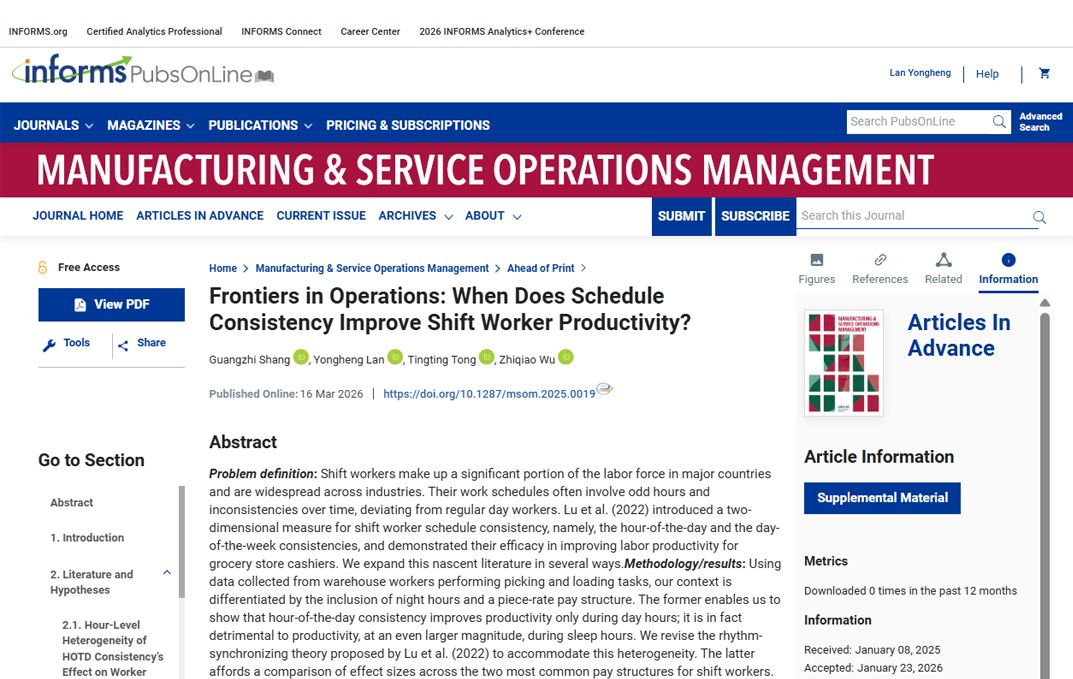
A collaborative paper by Assistant Professor Yu Haoran from the Institute of Supply Chain Management at Dongbei University of Finance and Economics (DUFE), titled ‘Retailing Strategies of Imperfect Produce and the Battle Against Food Waste’, has been officially accepted for publication in Manufacturing & Service Operations Management (MSOM), a leading international journal. The study was co-authored by Professor Burak Kazaz of Syracuse University and Professor Fasheng Xu of the University of Connecticut.
Abstract:
Problem Definition: Imperfect produce---edible but cosmetically flawed fruits and vegetables---is often excluded from store shelves, contributing significantly to food waste. Commercializing imperfect produce presents a promising opportunity to reduce waste. This study examines how grocery retailers can best choose from three common retailing strategies: discarding imperfect produce, bunching it with cosmetically perfect produce, or differentiating by selling perfect and imperfect produce separately at different prices. Methodology/Results: We develop analytical models that capture consumers' purchase behaviors under each retailing strategy. These models account for varying consumer preferences and quality perceptions to determine optimal retailer choices and their implications for food waste reduction. Our analysis identifies the specific market conditions under which each retailing strategy becomes optimal. We then examine two widely discussed policy interventions aimed at reducing food waste: (i) educating consumers to improve their perception of imperfect produce, and (ii) relaxing the tolerance limits for the amount of imperfect produce allowed into retail stores. We find that educating consumers about the value of imperfect produce may inadvertently reduce sales of perfect produce through cannibalization, potentially leading to increased amount of unsold perfect produce and lower profits. This economic pressure can cause retailers to switch from the differentiating strategy to the discarding strategy, paradoxically increasing food waste. Additionally, relaxing tolerance limits may merely shift food waste from farms to retail stores when retailers employ either discarding or differentiating strategies. Our study incorporates three extensions---upcycling imperfect produce into by-products, adopting mixed strategies that combine multiple approaches, and implementing full-shelf ordering policies---which confirm the robustness of our main findings. Managerial Implications: This research provides retailers with actionable insights for selecting optimal strategies to manage imperfect produce based on specific consumer preference profiles and market conditions. For policymakers, we offer recommendations that highlight the potential unintended consequences of well-intentioned interventions, suggesting more nuanced approaches to effectively reduce food waste across the supply chain.
Manufacturing & Service Operations Management, one of the UTD24 top journals in management, enjoys exceptional academic prestige worldwide and boasts an impact factor of 4.8 for the 2024–2025 period. This research marks the 23rd UTD24 journal article published with the Institute of Supply Chain Management at DUFE listed as the affiliated institution. The institute has consistently pursued innovation in high-quality research output and has achieved remarkable milestones, including an average of one UTD24 publication and one granted National Natural Science Foundation of China project per faculty member.
Looking ahead, the institute will continue to strengthen its platform for high-level academic exchange, promote well-organized and high-quality research initiatives, and support the development of the university’s ‘Double First-Class’ initiative with a more global vision. These efforts will further enhance the university's international academic influence, policy advisory capacity, and societal impact in this field.
Written by: Wang Ge
Source: Institute of Supply Chain Management