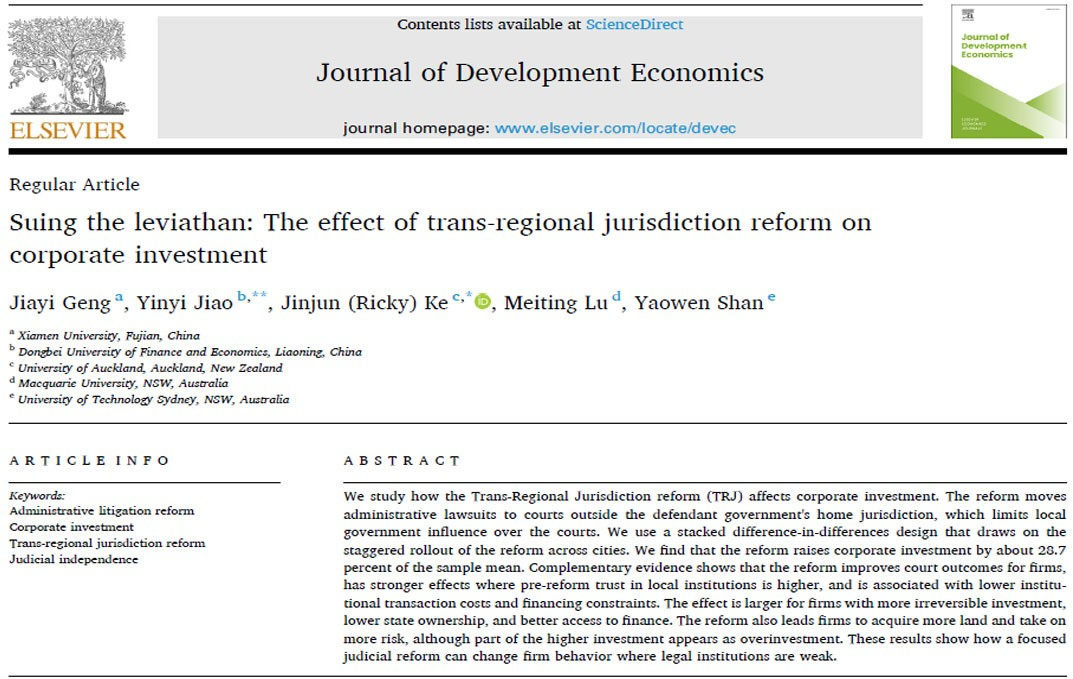
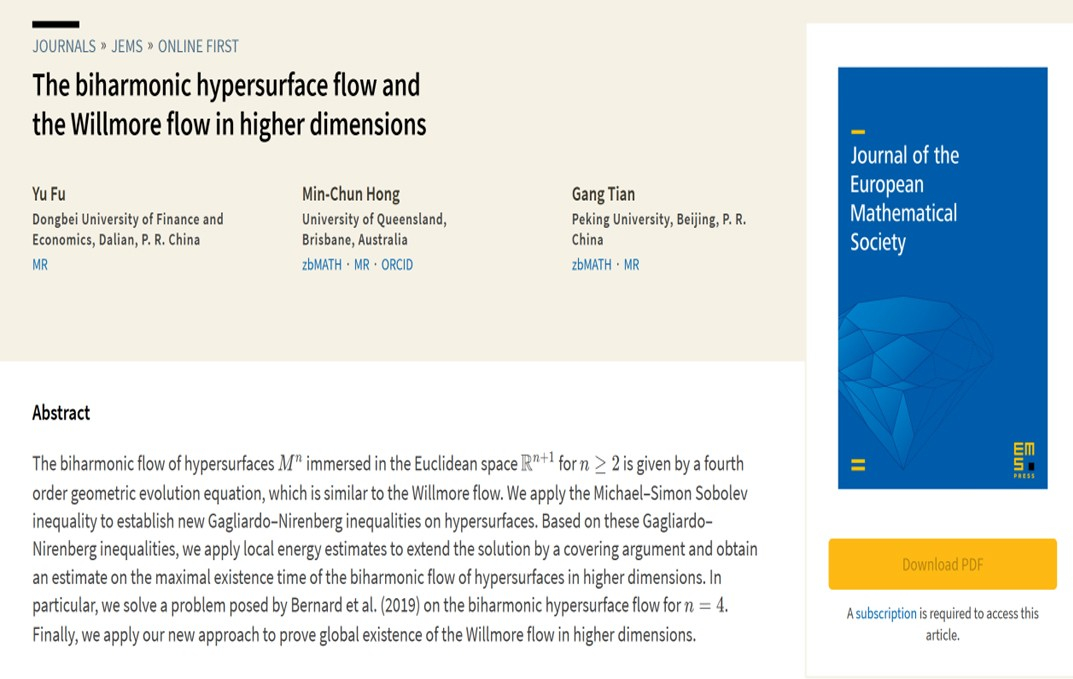
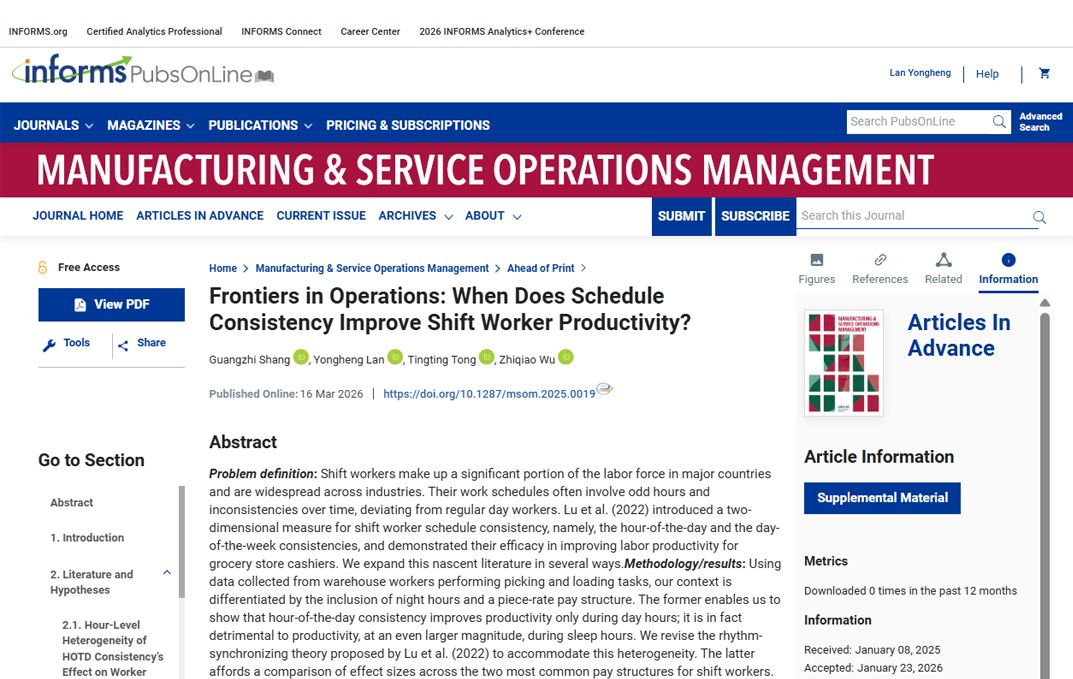
Recently, the collaborative paper titled “Impact of server capability on pooling configuration in stochastic service systems,” co-authored by Associate Professor Zhu Taozeng from the Institute of Supply Chain Analytics at DUFE, has been officially accepted and published in Production and Operations Management, a top-tier international journal. His co-authors include Associate Professor Yanting Chen from the University of Shanghai for Science and Technology, Associate Professor Jingui Xie from the Technical University of Munich, doctoral candidate Nan Yang from the Technical University of Munich, and Professor Zhe George Zhang from Western Washington University in the United States.
In service systems, resource pooling is commonly adopted to address fluctuations in customer demand. The core objective of building a more flexible system is to enhance resource utilization efficiency—specifically, assigning customer requests to available non-dedicated resources when their dedicated resources are fully occupied (known as off-service placement). Under this configuration, service system managers aim to serve more customers within a fixed timeframe. However, recent empirical evidence indicates that due to limited server capability, service times at non-dedicated resources are often significantly longer than those at dedicated ones.
To address this issue, the study develops a two-server stochastic model to examine how server capability levels, overall workload, demand asymmetry, and other factors influence pooling configurations. The research derives conditions for the optimal flexibility configuration under different parameter combinations. Key findings reveal that a partially flexible system can outperform a fully flexible one, particularly in scenarios characterized by low server capability and asymmetric demand. This advantage remains prominent when considering various system costs—including server capability costs, cross-serving costs, and other related expenses—in both buffered and non-buffered stochastic service systems. The insights from this two-server model provide valuable guidance for designing more efficient flexibility in complex multi-class, multi-server service systems.
As one of the UTD24 journals in management, Production and Operations Management holds an eminent academic reputation in the international management community. It boasts an impact factor of 4.8 for 2024-2025 and an average impact factor of 6.0 over the past five years. This research marks the 26th publication in a top-tier international journal (UTD24) with the Institute of Supply Chain Analytics as the affiliated unit.
Adhering to the pursuit of high-quality scientific research and innovation, the institute has achieved remarkable results: an average of 1.5 UTD24 journal articles per researcher and one National Natural Science Foundation of China (NSFC) project approval per researcher. Moving forward, the institute will continue to strengthen the development of high-level academic exchange platforms, systematically promote high-quality research, and support DUFE’s first-class discipline construction in Business Administration and its “Double First-Class” initiative with a broader international perspective. This will further enhance the university’s influence in international academia, policy advisory, and social services within this field.
Written by: Wang Ge & Zhang Ying
Source: Institute of Supply Chain Analytics