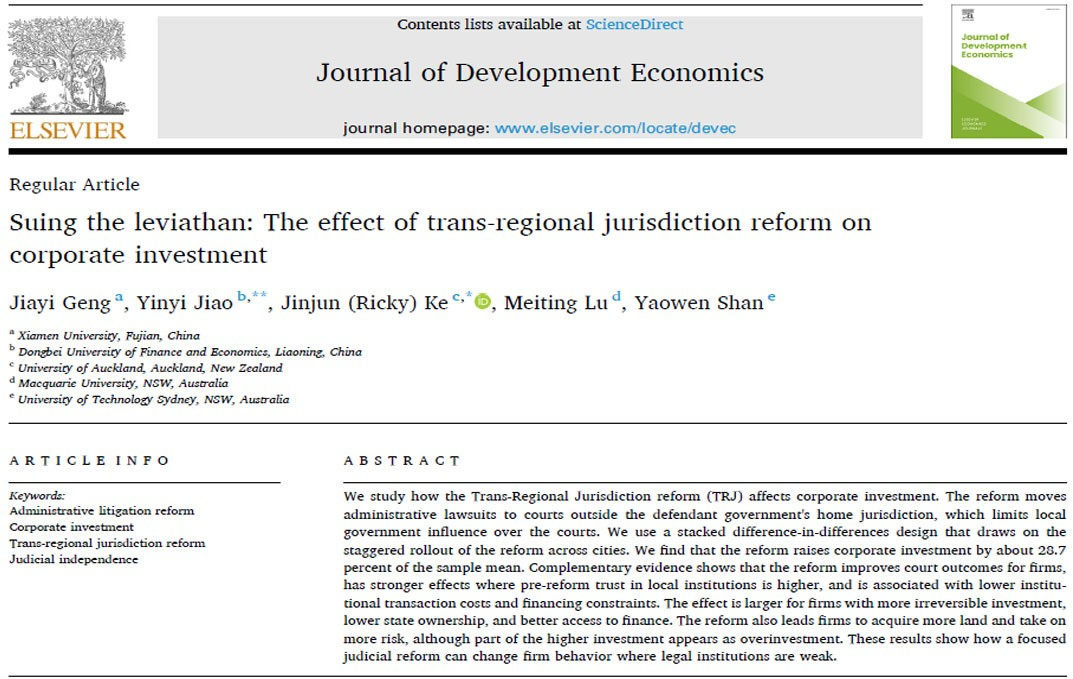
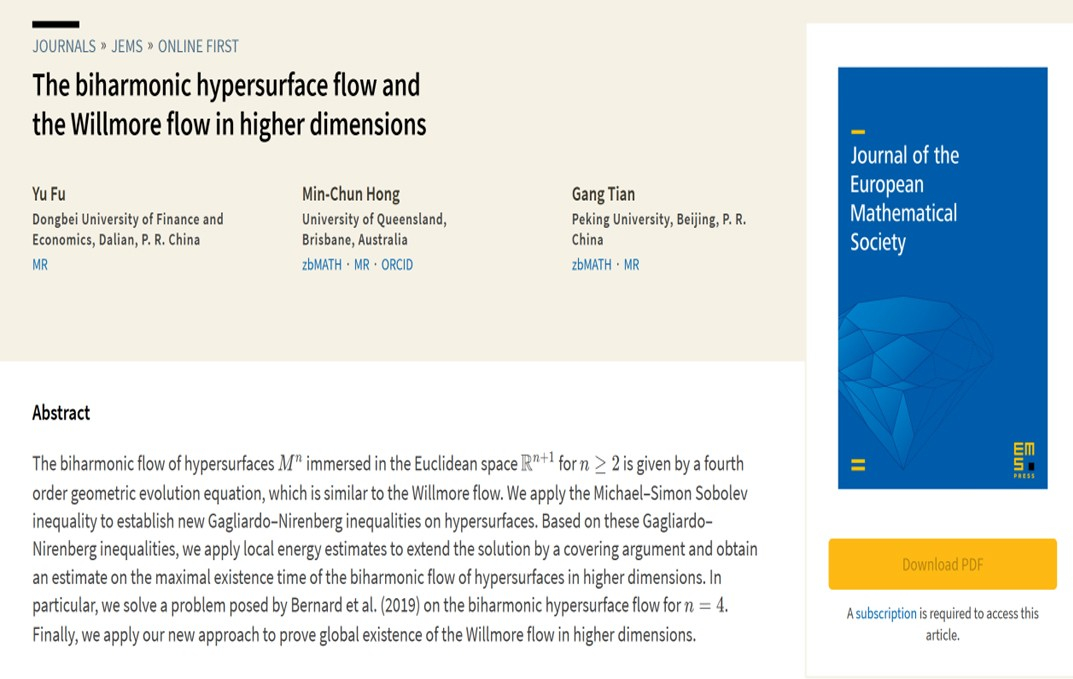
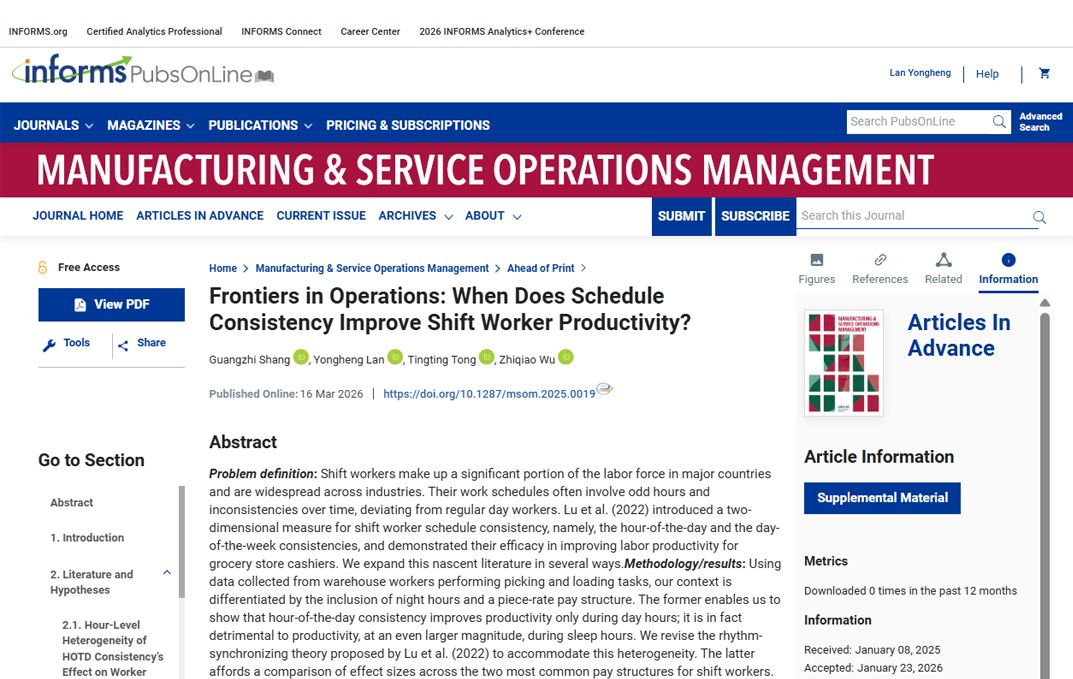
Recently, the research paper titled “Frontiers in Operations: When Does Schedule Consistency Improve Shift Worker Productivity?”, co-authored by Professor Tong Tingting from the Institute of Supply Chain Analytics, Professor Wu Zhiqiao from the School of Management Science and Engineering and the Key Laboratory of Big Data Management and Optimization Decision-Making of Liaoning Province, Ph.D. candidate Lan Yongheng from Dongbei University of Finance and Economics, and Associate Professor Shang Guangzhi from Arizona State University, has been formally accepted for publication by Manufacturing & Service Operations Management (M&SOM), a top-tier international journal in operations management. The paper is published in the journal’s highly selective “Frontiers in Operations” initiative.
The Frontiers in Operations initiative is reviewed by a panel consisting of the journal’s Department Editors and senior editors, and is convened only once every two years. The review panel spoke highly of the study, noting that the paper is innovative, makes an insightful contribution to staffing research by incorporating key behavioral dimensions, and offers clear managerial implications. The reviewers also praised the paper for its unique and detailed micro-level data from JD Logistics, as well as the authors’ rigorous approaches to addressing omitted variable bias and endogeneity concerns.
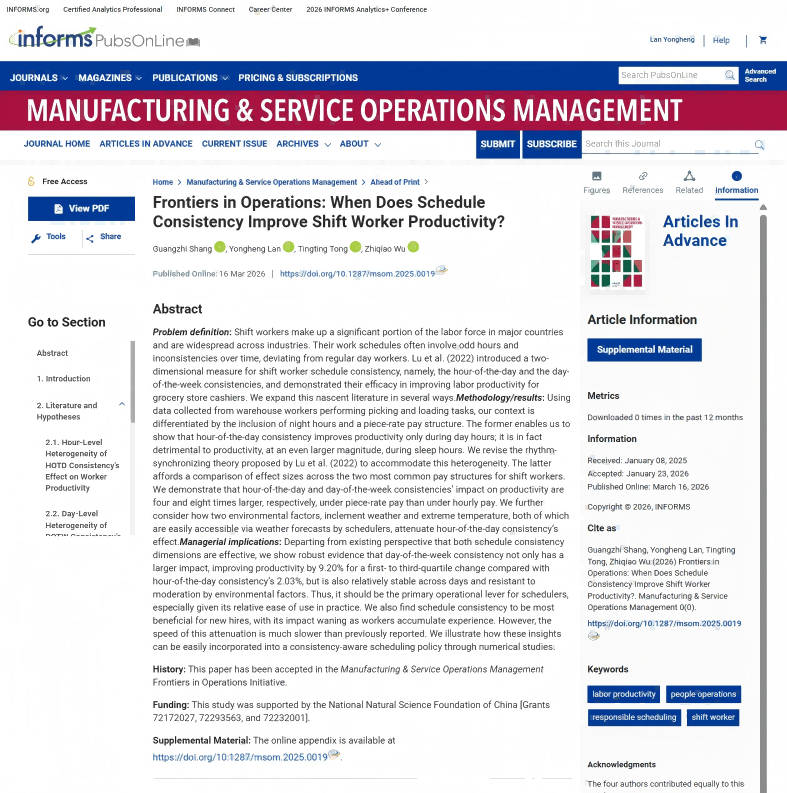
Focusing on warehouse picking and loading tasks, the study examines the relationship between schedule consistency and worker productivity under two critical operational features: night shifts and a piece-rate pay system. Building on prior research, the authors extend the rhythm-synchronizing perspective and provide a more refined understanding of when schedule consistency enhances performance.
The study yields several key findings. First, hour-of-the-day consistency is not universally beneficial: while it boosts productivity during regular daytime hours, it adversely affects productivity during sleep hours, with an even stronger negative impact. Second, under piece-rate pay, the productivity effects of schedule consistency are substantially stronger than those documented under hourly pay: the effects of hour-of-the-day consistency and day-of-the-week consistency are approximately four times and eight times larger, respectively. Third, compared with hour-of-the-day consistency, day-of-the-week consistency is more robust and operationally valuable. A first-to-third quartile improvement in day-of-the-week consistency raises productivity by 9.20%, compared with 2.03% for hour-of-the-day consistency. The study also reveals that schedule consistency delivers the greatest benefits to new hires, and the decline of these benefits with accumulated work experience is much slower than previously documented.
In addition, the authors explore how environmental factors such as inclement weather and extreme temperature affect the productivity value of consistent schedules. They find that these factors weaken the positive effect of hour-of-the-day consistency, while day-of-the-week consistency remains relatively stable. Based on these findings, the paper develops a consistency-aware scheduling policy via numerical studies, demonstrating how managers can optimize labor allocation by prioritizing day-of-the-week consistency, especially for new hires and in complex operating environments.
M&SOM is the flagship operations management journal published by the Institute for Operations Research and the Management Sciences (INFORMS). It is listed in both the UTD24 and the FT50 journal rankings, and is widely recognized as one of the top-tier international journals in management science. This publication represents another landmark achievement of DUFE’s research team based on data from JD Logistics’ smart fulfillment center, and marks the 27th UTD24 paper published by the Institute of Modern Supply Chain Management.
Written by: Tingting Tong, Yongheng Lan
Source: School of Management Science and Engineering, Institute of Supply Chain Analytics